
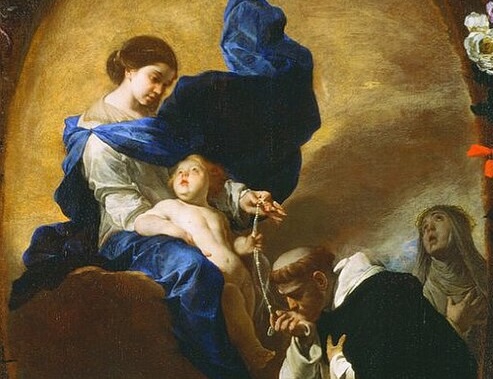
The Rosary developed gradually over many centuries rather than appearing all at once. While Catholic tradition holds that the Blessed Virgin Mary gave the Rosary to St. Dominic in the early thirteenth century, historians recognize that the devotion took shape over time as Christians combined meditative prayer with repeated recitation of the Psalms, the Our Father, and later the Hail Mary. Today, the Rosary remains one of the Church’s most beloved ways of contemplating the life of Jesus Christ.
A Prayer That Developed Over Time
Many people are surprised to learn that the Rosary did not begin exactly as we pray it today.
In the early centuries of Christianity, monks prayed all 150 Psalms each week. Since most laypeople could not read and did not have access to the Scriptures, they developed simpler prayer rules that mirrored the rhythm of the Psalms. Instead of praying all 150 Psalms, many prayed 150 Our Fathers, often counting them on a cord with knots or beads.
As devotion to the Blessed Virgin Mary grew, the Hail Mary gradually became the prayer most closely associated with these prayer beads. Over time, Christians began connecting these repeated prayers with meditation on the mysteries of Christ’s life, giving rise to what we now know as the Rosary.
Discover the Bible Behind Every Mystery of the Rosary
(My practical & FREE guide to deepen your prayer of the Rosary – Get easy-to-use reference guides with summaries, sacred art, prayerful reflections, and more for all 20 mysteries!)
The Tradition of St. Dominic
According to a long-standing Catholic tradition, the Blessed Virgin Mary appeared to St. Dominic around the year 1208 and encouraged him to preach the Rosary as a powerful means of conversion and spiritual renewal.
Whether every detail of that tradition can be historically verified has been the subject of scholarly discussion. What is beyond dispute, however, is that the Dominican Order became one of the greatest promoters of the Rosary, helping to spread the devotion throughout the Church for centuries.
As Catholics, we need not choose between history and tradition. It is entirely reasonable to recognize that the Rosary developed gradually while also believing that Our Lady played a special role in encouraging and promoting this devotion through St. Dominic.
Why the Rosary Endures
The enduring popularity of the Rosary is not simply because of its history but because of where it leads us.
At its heart, the Rosary is a meditation on the Gospel. The Joyful, Luminous, Sorrowful, and Glorious Mysteries invite us to contemplate the most important events in the life of Jesus Christ. As our lips repeat familiar prayers, our minds and hearts dwell on the mysteries of our salvation.
One of the things I’ve come to appreciate after years of studying Scripture and teaching Bible studies is that the Rosary has an extraordinary way of helping us slow down. Rather than merely reading about Christ’s life, we are invited to remain with Him… to ponder His words, His actions, His suffering, and His glory. In that sense, the Rosary is much more than a collection of prayers. It is a school of contemplation.
As St. John Paul II wrote in Rosarium Virginis Mariae:
“To recite the Rosary is nothing other than to contemplate with Mary the face of Christ.”
I think that beautifully captures why this devotion has remained at the heart of Catholic spirituality for so many centuries.
Conclusion
The Rosary was not invented overnight. It emerged gradually from the prayer life of the Church, drawing together biblical prayers, meditation on the mysteries of Christ, and centuries of Christian devotion.
Whether we look to its historical development or to the tradition of St. Dominic, the purpose of the Rosary has always been the same: to help believers grow in communion with Jesus Christ. Ultimately, its origin matters not simply because of where it came from, but because of where it leads us: ever more deeply into the mystery of the Gospel.
