
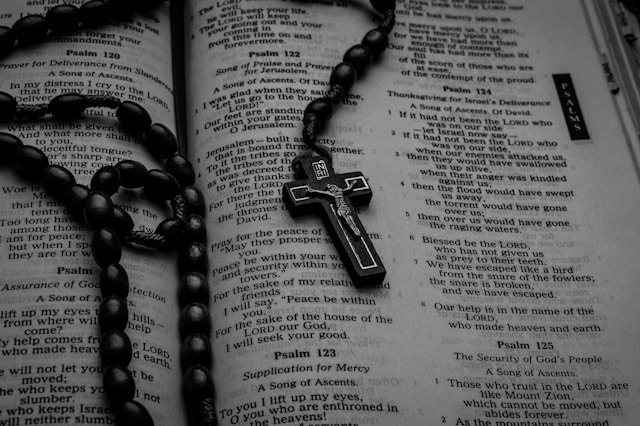
Yes. Although the Rosary is not found as a single prayer in the Bible, it is deeply rooted in Sacred Scripture. The principal prayers of the Rosary come from the Bible, its mysteries invite us to meditate on key events in the life of Jesus Christ, and its purpose reflects the biblical call to contemplate God’s saving works. In this sense, the Rosary is one of the most scriptural devotions in the Catholic tradition.
The Rosary Is Centered on the Life of Christ
One of the most common misunderstandings about the Rosary is that it is primarily a prayer about Mary. While the Blessed Virgin certainly has an important place within it, the Rosary is ultimately about Jesus Christ.
Each decade invites us to meditate on one mystery from His life—from the Annunciation and His Nativity to His Passion, Resurrection, and the sending of the Holy Spirit. Rather than distracting us from Christ, the Rosary continually directs our attention back to Him.
One of the things I’ve come to appreciate through years of studying Scripture and leading Bible studies is that the Rosary helps us read the Gospels more slowly. Instead of rushing through familiar passages, we linger with them. We watch Christ act. We listen to His words. We allow the Holy Spirit to form our hearts through repeated meditation on the mysteries of His life.
The Prayers of the Rosary Come from Scripture
Many people are surprised to discover just how biblical the Rosary’s prayers actually are.
The first half of the Hail Mary comes directly from the Gospel of Luke. The angel Gabriel greets Mary, “Hail, full of grace, the Lord is with you” (Luke 1:28), and Elizabeth later proclaims, “Blessed are you among women, and blessed is the fruit of your womb” (Luke 1:42).
The Our Father, of course, was given to us by Jesus Himself (Matthew 6:9–13), while the Glory Be echoes the biblical pattern of giving glory to the Father, Son, and Holy Spirit.
Even the second half of the Hail Mary flows naturally from Scripture. After seeing how God worked through Mary in the Bible, Christians have long asked for her prayers, just as believers ask one another to pray for them (James 5:16).
The Rosary Reflects a Biblical Way of Praying
Beyond its individual prayers, the Rosary reflects a deeply biblical pattern of prayer.
Throughout Scripture, God’s people repeatedly recall His saving works. Israel remembered the Exodus. The Psalms continually rehearse God’s mighty deeds. Mary herself magnifies the Lord by reflecting on what He has done throughout salvation history. Jesus tells His disciples to “do this in remembrance of me.”
The Rosary belongs to this same tradition. Rather than empty repetition, it is a prayer of remembrance. As our lips repeat familiar prayers, our minds and hearts are drawn into the great events through which God accomplished our salvation.
In my own experience, this is where the Rosary changed for me. It ceased being merely a collection of prayers and became a way of entering more deeply into Scripture itself. The mysteries are not random scenes from the Gospel. Together they tell one unified story—the story of God’s plan to save the world through Jesus Christ.
Scripture and the Rosary Belong Together
Perhaps the best way to understand the Rosary is to think of it as praying the Bible with Mary.
For centuries, Catholics have turned to this devotion not because it replaces Scripture, but because it continually leads them back to Scripture. Every mystery invites us to contemplate another page of the Gospel. Every decade draws us deeper into the life, death, and resurrection of Christ.
As someone who teaches Scripture regularly, this is one of the reasons I continue to recommend the Rosary so often. It has an extraordinary way of helping people move beyond simply reading biblical passages to truly praying them. The Rosary forms not only our minds, but also our hearts, as we learn to see Christ through the eyes of His Mother.
Conclusion
So, is the Rosary biblical? Absolutely.
Not because every word appears together in a single passage of Scripture, but because the entire devotion is woven from the fabric of God’s Word. Its prayers echo Scripture, its mysteries are drawn from Scripture, and its purpose is profoundly biblical: to know Jesus Christ more deeply by prayerfully contemplating His saving work.
When prayed well, the Rosary is not an alternative to reading the Bible. It is one of the Church’s most beautiful ways of praying with the Bible, allowing the Word of God to take root in our minds, shape our hearts, and draw us into deeper communion with Christ.
